U3A Settle
Art Appreciation
2024/25
Our June meeting was on the 3rd.
We had a pot pourri of short items.
Kathy Grieve told us about
the world’s favourite picture, not the current favourite, but the mid 19th
century favourite, Holman Hunt’s Light of the World. In truth there are 3
versions, and the third one toured the world to great acclaim. And yet
one of them was donated to Keble College Oxford, where it seems to have
been a bit controvertial.
Moving from a favourite picture
Richard Vesey told of a favourite art gallery, the Whitechapel.
Its origins in
East London were philanthropic with the aim of making real art available
to the man (or woman) on the Clapham omnibus. It stages exhibitions, and
does not hold a permanent collection.
By contrast, I told of a favourite of mine, the Courtauld, which
holds some of the world’s most loved paintings, especially from the
Impressionist and post-Impressionist time. It is so good to see these
famous works in such an intimate setting. Samuel Courtauld a wealthy
textile magnate collected these works in the early days of modernism.
We visited the Courtauld website (courtauld.ac.uk/gallery/),
where there is a
short eulogy by Bill Nihy,
and a virtual tour of the gallery’s permanent collection.
We rounded off with Sister Wendy Beckett’s short video about modern art.
We plan to reconvene in October.
Our May meeting was scheduled for the 6th.
It was not possible to assemble a programme of presentations.
Instead, the idea was to visit
Abbot Hall in Kendal.
There is
an exhibition of modern portraits from a variety of artists.
Abbot Hall is not open on Tuesdays, so the visit was on the afternoon of Thursday 8 May 2025.
This fell on the 80th anniversary of VE day,
and when you looked at the list of artists, many of them had been displaced by World War II.
Frank Auerbach’s portrait of his wife, made up of pencil lines, was particularly striking.
As a group event it was a failure and rather resembled Eleanor Rigby’s funeral.
As a personal visit, it was good in parts.
Our April meeting fell on April Fools’ Day.
We explored the theme of trompe-l’œil,
which translates as “fool the eye”.
David Holdsworth took us to the website of a 19th century dutch panorama,
which they had visited last year.
He had wrongly thought that the phrase referred to optical illusions, but discovered it
is most often used more widely.
We discussed how 2-dimensional marks can give us a sense of 3 dimensions,
even though our own retina is itself 2-dimensional.
In fact we have two retinas, and Roger Taylor told us of his
collaboration with Brian May looking at 19th century stereo images.
David’s own 3D experiments can be
seen here.
Ultimately a work of art is about producing impressions in the viewer’s brain.
We ranged from perspective to Picasso, Canaletto to cubism, and Holbein to Hockney,
with generous reference to the latter’s Secret Knowledge.
Sue Cariss then raised questions about ownership of works of art by telling us of two works
by the Spanish impressionist Joachim Sorolla which disappeared into private hands over 100 years ago and were thought lost,
but which reappeared in an exhibition in Madrid in December 2024.
It closes later this month, when the works will return to obscurity.
Though one of the pictures did emerge at auction in 2017, but was sold to a private buyer.
Our March meeting was on the 4th.
Diane Dillon told us of her enthusiasmfor "The Meeting on the Turret Stairs",
voted Ireland’s favourite painting in 2012.
The picture is of a meeting on the
stairs between Princess Hellalyle and her soldier lover Hildebrand, a
liaison not popular with the king whose ire led on to a bloodbath of
Shakespearean proportions.
The story is told in a Danish poem, of which Diane gave us a translation.
This water-colour is by Frederic William Burton who became Director of the National Gallery in London where
he acquired around 500 paintings,
including the The Ambassadors by Holbein, which has something to offer on the trompe-l’œil. theme.
Nick Temple gave us a professional enthusiast’s background to le
Corbusier, a man of prodigious talent whose achievements go way beyond
high-rise modern architecture. A man for whom the modernism after World
War 1 was his very life-blood, as a painter as well as architect. He saw
a building not just as itself but as an integral part of its surroundings.
Nick showed us how Le Corbusier’s love of the horizon could be seen in
the lines of his buildings, both interiors and exteriors. He was even
chosen to build a church despite being an atheist himself.
It was interesting to compare his pre-war work with that done after 1945.
Our February meeting was on the 4th, in an unfamiliar room but with our
familiar format of 2 talks from members of our group
Rorie Grieve resumed the story of the French impressionist Berthe Morisot, especially the
difficulties for a woman operating in a man’s world. There were some
wonderful non-PC quotes from her contemporaries.
Despite her sex she missed only one of the Impressionist Exhibitions,
which coincided with motherhood.
Not only did she exhibit, she did much of the organisation.
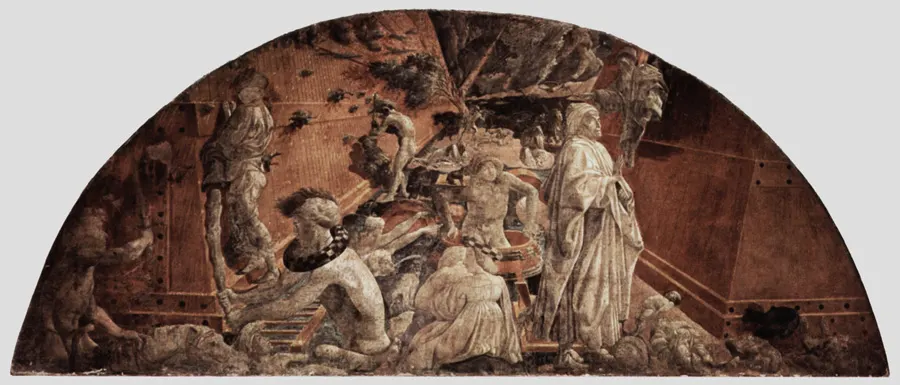
Nick Temple then took us to Italy, to a 15th
century fresco of the biblical flood and 20th century flooding
that damaged it in 1966.
We looked at the
way that perspective was initially seen more as a way of
taking the viewer forward, and how the horizon can
trigger ideas of the infinite.
We really got quite philosophical at times.
Our January meeting was on the 7th.
Sue Vickerman told us about the story behind her exhibition at the Folly,
Translating the Body
which had closed just 3 days previously, and had been seen by several of our group.
We started with a 25 minute film featuring Sue as curator and model, and all of the artists
whose work was on display.
This sparked a lively discussion around the dynamic between artist and model
Sue Simpson introduced us to the exhibition at the Bowes Museum, entitled
Kith and Kinship: Norman Cornish and L. S. Lowry.
This exhibition closed on Sunday 19th January, so there was still chance to go
and see the work of two very different artists who both depicted working class life
around the end of the seond world war.
Now you can only make a virtual visit.
 Our December meeting ranged widely visiting the 17th,
19th and 20th centuries.
Richard Vesey introduced Surrealism, a deliberate irrationality evolving from the irrational
madness of the first world war.
There was much
discussion among the group, with particularly widely differing views of
Dalí’s surrealist Persistence of Memory, with its famously unreal soft watches.
Jean Djavanroodi took us back to the
1600s and her love of a van Dyke portrait of 2 brothers,
two 17th century toffs, sure of themselves
in their fashionable finery, superbly portrayed by van Dyke.
Rorie Grieve only had time to give us the beginnings of Berthe Morisot’s
career, a woman battling in a man’s world,
where she was initially more sought after as a sitter then a painter.
Rorie’s next session in February will reveal how she is now regarded
as one of the major impressionist painters.
Our November meeting was on Bonfire Night
when John Thurwell took us into the fantastical world of the
mediæval mind. He gave us an eye-opening reworking of some
material about Hieronymous Bosch, a Dutch painter born about 1450.
His exquisitely worked
paintings of imaginary scenes of paradise or hell give us a hint of
mediaeval myth with a strange echo of Salvador Dalí.
Surely Dalí would
have seen his paintings, given that King Philip II of Spain was a fan and
acquired several of Bosch’s paintings which are now in the
Prado Museum in Madrid.
We had also planned for Sue Simpson to talk about Norman Cornish and
L.S.Lowrey, but technology thwarted us, and Sue Cariss stepped into the
breech and talked about lapis lazuli
( Na7Ca(Al6Si6O24)(SO4)(S3) · H2O )
the fabulously expensive ultra-marine
blue pigment from Afganistan.
Vermeer’s enthusiasm for lapis lazuli was one reason why he died
virtually guilderless.
Our format usually involves a few volunteers who stand up and share their opinions of particular works
of art or art in general with the rest of the group.
Click here to see what happened last year.
Here is a list of currently unused offers to date.
- Sue Simpson — art and music
- Kairen Bradley talking about hjer own work
- Sue Simpson — Canadian artists working around The North shores of Lake Superior at the beginning of the 20th Century
- Jackie Allott — Peter Doig
- Nicholas Temple — Stanza della Segnatura - fresco cycle by Raphael in the Vatican 16th century
- Nicholas Temple — Diptych painting of the artist’s studio, Casper David Friedrich early 19th century.
Please
send me an e-mail
to let me know if you would like to offer something to add to this list.
If you have already made an offer and it is not included above, my sincere apologies for
inept organisaton are freely offered.
And thanks to all those who have offered to contribute.
Contributions can be of any length, and I will provide help for anyone who wants assistence with
projecting pictures.
Last season’s visit to the newly re-opened Abbot Hall was aborted
when we discovered that the gallery’s opening times
did not include Tuesdays.
A member of our group has since been, and reported being underwhelmed.
David Holdsworth
Click here to see the programme of our 2023/24 season
Either because you want to be reminded of what a good time we had, or because
you are someone contemplating joining the group.